The Sequel – Day 13

April 20, Monday

2nd JourneyThe church sent them on their way; and they headed down through Phoenicia and Samaria, telling the story of the conversion of the Gentiles as they went. All the brothers were overjoyed to hear about it. Upon their arrival at Jerusalem they were welcomed by the church and by the apostles and elders. They reported all that God had done through them. But some members of the Pharisees’ party who had become believers stood up and declared that it was absolutely essential that these new believers be told that they must be circumcised and observe the Law of Moses.

The apostles and elders met to consider the matter. Finally, after much debate, Peter stood up and addressed the group: “Men and brothers, you know that in this matter of taking the Message to the Gentiles, God chose me to be the first to carry it to them when He sent me to Cornelius. God, who knows the hearts of all, confirmed that He had cleansed their hearts when He gave them the Holy Spirit just as He had us. He made no distinction between their faith and ours.

“So why would you further test God by putting a burden on the shoulders of these disciples which neither our fathers nor we were able to bear? There is no denying that it is by the grace of the Lord Jesus that we are saved by faith, just as they are!”

This quieted the crowd, and they listened as Barnabas and Paul gave a detailed account of the signs and wonders which God had worked through them among the Gentiles.

At the conclusion of their report, James spoke up, saying, “Men and brothers, listen to me. Peter has explained how God went about taking from among the Gentiles a people for His name. This is not a new concept. Even the prophets wrote as much in the Scripture, saying, ‘After this I will return and will rebuild the tabernacle of David which has fallen down. I will rebuild its ruins, and I will set it up so that the rest of mankind may seek the Lord, even all the Gentiles who are called by My name, says the Lord Who brings about things foretold long ago.’

“I do not believe that we should put any additional obstacles in the way of these Gentiles who are turning towards God. Instead, I think we should write to them, telling them to avoid anything polluted by idols, sexual immorality, eating the meat of strangled animals, or tasting blood. These regulations are commonly known since Moses has been read aloud in the synagogues every Sabbath day in every city.”

Then it seemed good to the apostles, elders, and the whole church to choose representatives and send them to Antioch with Paul and Barnabas. Judas, surnamed Barsabbas, and Silas, both leading men of the brotherhood, were chosen to carry this letter:

“The apostles and elders send their greetings to our brothers who are Gentiles in Antioch, Syria, and Cilicia. Since we have heard that some of our number have caused you deep distress and have unsettled your minds by giving you a message which certainly did not originate from us, we are unanimously agreed to send you chosen representatives with our well-loved Barnabas and Paul, men who have risked their lives for the name of our Lord Jesus Christ. We have sent with them Judas and Silas who will give you the same message personally by word of mouth. For it has seemed right to the Holy Spirit and to us to lay no further burden upon you except what is absolutely essential, namely, that you avoid what has been sacrificed to idols, tasting blood, eating the meat of whatever has been strangled, and sexual immorality. Keep yourselves free of these things and you will make good progress. Farewell.”

And so the group was sent to Antioch, carrying the letter. Upon their arrival the believers gathered and the letter was read, resulting in great rejoicing. Judas and Silas had much to say to the believers by way of encouragement and instruction. After some days they returned to Jerusalem. Paul and Barnabas stayed on in Antioch, teaching and preaching the Word of the Lord along with many others.

Some days later Paul spoke to Barnabas, “We should go back and visit the brothers in every city where we have proclaimed the Word of the Lord, to see how they are doing.”

Barnabas agreed and wanted to again take John, surnamed Mark, as their companion. Paul refused to take along one who had deserted them in Pamphylia and who was not prepared to go the distance with them in their work. There was such a sharp disagreement that they parted ways.  Barnabas ended up taking Mark and sailing to Cyprus.

________________

Paul recruited Silas; and together they set out on their journey, commended to the grace of the Lord by the brothers in Antioch. They travelled through Syria and Cilicia, strengthening the churches and from there went on to Derbe and Lystra.

At Lystra there was a disciple by the name of Timothy whose mother was a Jewish believer, though his father was a Greek. Timothy was highly respected by all the brothers at Lystra and Iconium, and Paul wanted to take him on as his companion. Everybody knew his father was a Greek, so Paul had him circumcised because of the attitude of the Jews in that region. As they went from city to city, they shared the letter from the apostles and elders in Jerusalem, explaining the instructions. As a result the churches grew stronger and their numbers increased daily.

________________

They continued on through Phrygia and Galatia, but the Holy Spirit prevented them from speaking God’s message in Asia.  When they came to Mysia and tried to enter Bithynia, again the Spirit of Jesus would not allow them. So they skirted Mysia and came down to Troas. While there, Paul had a vision of a man from Macedonia calling to him in these words: “Come over to Macedonia and help us!”

Paul, recognizing this as a call from God to take the good news into Europe, immediately began making plans to sail from Troas. I, Luke, joined them there; and we put out to sea, sailing directly to Samothrace, then on to the port of Neapolis. From there we set off for Philippi, a Roman garrison town and the chief city in that part of Macedonia.

The Sequel – Day 12

April 19, Sunday

Not ZeusUpon their arrival in Iconium, they went to the Jewish synagogue and spoke with such conviction that a very large number of both Jews and Greeks believed. But again, some unbelieving Jews stirred up some of the Gentiles and poisoned their minds against the brothers. Nevertheless, they remained there for a long time and spoke fearlessly for the Lord. He confirmed their testimony by granting power to perform signs and miracles.

The people of the city were divided in their opinions, some taking the side of the Jews, and some that of the apostles. Finally, when the apostles got wind of a conspiracy by both Gentiles and Jews in collaboration with the authorities to have them stoned, they fled to the nearby cities of Lystra and Derbe and continued to proclaim the Message throughout the surrounding countryside.

________________

At Lystra they encountered a lame man who had suffered this handicap since birth. He was listening to Paul as he spoke, and Paul, looking him straight in the eye, perceived that he had the faith to be made well. So he said in a loud voice, “Stand straight up on your feet!” Immediately he sprang to his feet and began walking. When the crowd saw what Paul had done, they shouted in the Lycaonian language, “The gods have come down to us in human form!” They began to call Barnabas, “Zeus,” and Paul, “Hermes,” since he was the spokesman.  The next thing they knew, the high priest of the temple of Zeus had brought oxen to the gates and wanted to offer sacrifices to the two men.

As soon as Barnabas and Paul realized what was going on, they tore their clothes and rushed into the crowd, crying at the top of their voices, “Men, stop! Why are you carrying on like this? We are only human beings with feelings just like yours! We are here to tell you Good News, that you should turn from these meaningless things to the living God! He is the One who made heaven and earth, the sea and all that is in them. In the past He allowed all nations to go their own ways — not that He left you without evidence of Himself. In His kindness He sent you rain from heaven and fruitful seasons, providing you with food and making your hearts content.”

It was all they could do to keep the crowd from making sacrifices to them — that is, until some Jews arrived from Antioch and Iconium, who turned the minds of the people against Paul so that they stoned him and dragged him out of the city thinking he was dead. But while the disciples were gathered in a circle around him, Paul got up and walked back to the city. The next day he left there, taking Barnabas with him, and went to Derbe where they proclaimed the Good News and made many disciples.

________________

From Derbe they retraced their steps back through Lystra, Iconium, and Antioch, encouraging the disciples along the way, urging them to stand firm in the faith, and reminding them that it is “through many difficulties that we must enter into the Kingdom of God.” They appointed elders in each church and with prayer and fasting commended these men to the Lord in Whom they had believed. They continued on their journey through Pisidia to Pamphylia, on to Perga where they spoke the Word, and then down to Attalia.

Having finished their assignment, they sailed back to Antioch, to the church from which they had been commissioned to this special task by God’s grace. When they arrived there, they called the church together and reported to them the amazing things God had done and how He had opened the door of faith for the Gentiles. They remained at Antioch with the disciples for a long time.

At one point, some men came down from Judea to Antioch and began teaching the Gentile believers that they had to submit to circumcision as prescribed by Moses in order to be truly saved. Paul and Barnabas argued and debated long and hard until finally the believers decided to send them to Jerusalem along with a few others to settle the issue with the apostles and elders there.

The Sequel – Day 11

April 18, Saturday

Paul Elymas.jpgIncluded among the believers in the Church at Antioch were a number of prophets and teachers: Barnabas; Simeon from Niger; Lucius from Cyrene; Manaen, the foster-brother of Herod Antipas; and Saul. While they were worshipping the Lord and fasting, the Holy Spirit spoke to them, saying, “Set Barnabas and Saul apart for Me for a task to which I have called them.” After further fasting and prayer, they laid their hands on them and sent them on their way, John Mark accompanying them.

The Holy Spirit led them to the port city of Seleucia where they boarded a ship for the island of Cyprus. They explained God’s Message in the synagogues from Salamis to Paphos and throughout the island. In Paphos, the provincial capitol, they made the acquaintance of Sergius Paulus, the governor, a man of considerable intellect.  He summoned them, anxious to hear what they had to say. Now a Jewish magician by the name of Elymas was a personal advisor to the governor. When he heard them explaining the word of God, he tried hard to prevent the governor from taking hold of it.

Then the Holy Spirit filled Saul, who is also called Paul, with a rebuke for Elymas: “Why, you son of the devil! You’re as devious and deceptive as the devil himself, the enemy of all that is right, forever twisting the simple ways of the Lord. May the Lord touch you with blindness since you refuse to see the truth and would hinder others.” Instantly, something like a foggy mist came over Elymas; he had to get someone to lead him about. Witnessing this dramatic event convinced the governor of the truth of Paul’s message.

________________

From Paphos, Paul and the team sailed for Perga in Pamphylia on the mainland. John Mark turned back, however, and did not continue with them, returning instead to Jerusalem. After passing through Perga, they went on to Antioch in Pisidia. On the Sabbath they went to the local synagogue. After the reading of the Law and Prophets, the leaders of the synagogue invited them to speak, saying, “Men and brothers, if you have any message of encouragement for the people, by all means speak.”

Paul stood up and proceeded to give them a brief history of God’s dealings. “Fellow Jews and all of who fear God, listen to me. God chose our fathers and prospered the people of Israel while they were exiles in the land of Egypt. Then He demonstrated His power and led them out of that land after which time He put up with them for forty years in the wilderness. He destroyed seven nations in the land of Canaan and gave them that land as their inheritance.

“For the next four hundred and fifty years He gave them judges until the time of the prophet Samuel. The people begged for a king; so God gave them Saul the son of Kish, a man of the tribe of Benjamin, to be their king for forty years. Saul was replaced by David, a man of whom God Himself said, ‘I have found David, son of Jesse, a man after My own heart, who will do all My will.’

“And it is from the line of David that God, as He had promised, brought Jesus to Israel to be their Savior. Right before Jesus came, John the baptizer proclaimed the baptism of repentance for all the people of Israel. Toward the end of his ministry John said, ‘Who do you think I am? I am not He. Behold, Someone comes after me whose shoe-lace I am not fit to untie!’

“Brothers, sons of Abraham, and all who fear God, hear me when I tell you that this message of salvation has now been sent to us!  The people of Jerusalem and their rulers refused to recognize Him or to heed the prophets which are read every Sabbath day. In condemning Him they fulfilled these very prophecies!

“Even though they had no grounds for a death penalty, they begged Pilate to have him executed. When they had carried out everything that was written about Him, they took Him down from the cross and laid Him in a tomb. But God raised Him from the dead. For many days He was seen by His followers from Galilee. These men are now His witnesses to the world.

“We have come to tell you the Good News that the promise made to our forefathers has come true. God has fulfilled it by raising up Jesus as He foretold in the second Psalm: ‘You are my Son, today I have begotten You.’  When He said, ‘I will give You the sure mercies of David,’ God was affirming that He would be raised up never to see death again, as He mentions in yet another Psalm, ‘You will not allow your Holy One to see corruption.’

“It could not have been referring to David, you know, because after he had completed God’s plan for his life, he died and was laid with his ancestors. His body did experience decay, but this Man whom God raised never saw corruption!

“The point of all this is that forgiveness of sins is available to you through this Man. Everyone who entrusts themselves to Him is freed from all those things from which the Law of Moses could never set him free. Only be careful that this saying of the prophets should never apply to you: ‘Behold, you scoffers, marvel and perish; for I am doing something incredible in your day which you will by no means believe, even though it is explained to you.’”

As the people left the synagogue that day, they urged Paul to return the following Sabbath to share the message again. Many of the Jews and devout proselytes followed Paul and Barnabas, who spoke personally to them and urged them to put their trust in the grace of God.

On the next Sabbath almost the entire city gathered to hear the message of God; but when the Jews saw the crowds, they were filled with jealousy. They contradicted what Paul was saying and slandered him. Paul and Barnabas turned to the agitators and said, “We came to speak the Message of God to you first; but since you reject it and evidently do not think yourselves worthy of eternal life, we will turn our attention to the Gentiles!  In fact, the Lord commanded us to do so when He said: ‘I have set you to be a light to the Gentiles, that you should take the message of salvation to the ends of the earth.’”

When the Gentiles heard this, they were thrilled and responded wholeheartedly to the word of the Lord. All those who were destined for eternal life believed, and the Word of the Lord kept spreading throughout the region. But the offended Jews stirred up some of the prominent women and leading men, who, in turn, started a wave of persecution against Paul and Barnabas, ultimately forcing them to leave the area. Shaking the dust from their feet in protest, they went on to Iconium. The disciples continued to be full of joy and the Holy Spirit.

The Sequel – Day 10

April 17, Friday

Peter ReleasedNews of Peter’s interaction with Gentiles reached the group in Jerusalem, and the Jewish believers took issue with it. When Peter returned to Jerusalem, they confronted him, charging, “We hear that you actually shared a meal with uncircumcised men!”

Peter proceeded to explain the situation. “I was in the city of Joppa, praying,” he said, “when in a trance I saw a vision — something like a great sheet coming down towards me, let down from heaven by its four corners. It came right down to me. When I looked at it closely, I saw animals and wild beasts, reptiles and birds. Then I heard a voice say to me, ‘Get up, Peter, kill and eat.’ But I said, ‘Never, Lord, for nothing common or unclean has ever passed my lips.’ Then the voice from Heaven spoke a second time and said, ‘You must not call unclean what God has cleansed.’ This happened to me three times, and then the whole thing was taken up again into heaven. The next instant, three men arrived at the house where we were staying, requesting that I return with them to Caesarea. The Spirit told me in no uncertain terms to go with these men and not to doubt His leading in this matter.

“These six brothers accompanied me and we went into the man’s house. He told us how an angel had appeared in his house, saying, ‘Send to Joppa and bring Simon, surnamed Peter. He will give you a message which will save both you and your whole household.’ As I was beginning to tell them the Message, the Holy Spirit fell upon them just as He had on us at the beginning. Immediately I recalled that our Lord had told us, ‘John indeed baptized with water, but you will be baptized with the Holy Spirit.’ I figured that if God gave them exactly the same gift as He gave to us when we believed on the Lord Jesus Christ, who was I to get in the way of what God was doing?”

When they heard Peter’s story, they were convinced and they praised God, saying, “It’s obvious that God has given Gentiles the gift of repentance which leads to life!”

________________

Because of the persecution which began following Stephen’s martyrdom in Jerusalem, the Message spread out as far as Phoenicia, Cyprus, and Antioch, though exclusively among the Jews. However, some of the men, natives of Cyprus and Cyrene, shared the Good News of the Lord Jesus with Greeks in Antioch. The Lord blessed their efforts, and a large number turned to the Lord.

News of this reached the Church in Jerusalem, so they sent Barnabas to check it out. When he arrived in Antioch and saw the amazing grace of God at work, he was thrilled. He encouraged them all to remain true to the Lord, for he was a good man who trusted God for everything and lived by the promptings and power of the Holy Spirit. As a result, even more people became followers of the Lord.

Barnabas recognized the need for mature believers to help in the work, so he went to Tarsus to find Saul. When he found him, he brought him back to Antioch where for the next year they taught the growing congregation. It was in Antioch that the disciples were first given the name of “Christians” (a derogatory term meaning “Little Christs”).

Around this same time some prophets came down from Jerusalem to Antioch. One of them by the name of Agabus stood up and foretold by the Spirit that there would be a great worldwide famine.  So the disciples arranged to send relief to the brothers in Judea, each according to their resources. They asked Barnabas and Saul to take the contribution to the elders in Jerusalem.

________________

It was around this same time that King Herod, in an attempt to please the Jewish leaders, arrested several believers. He had James, the brother of John, executed with a sword. During the feast of Unleavened Bread he put Peter in prison, intending to deal with him after the Passover celebration. Herod assigned four squads of soldiers, a total of sixteen men, to guard him. The church, meanwhile, prayed fervently for Peter.

On the night before Herod was planning to bring him out, Peter was asleep between two soldiers, chained with double chains, with guards standing watch in the doorway of the prison. Suddenly an angel of the Lord appeared, and light filled the cell. He awakened Peter, tapping him on the side and said, “Quick! Get up!” The chains fell away and the angel said to him, “Get dressed and put on your sandals.”  Peter did so. Then the angel told him, “Put on your coat now, and follow me.” Peter followed him out but thought it was all just a dream. They passed through the first and second guard-points and came to the iron gate that led out into the city.  The gate opened for them automatically. When they got to the street, the angel disappeared.

By this point Peter realized he was very much awake and said to himself, “How about that! The Lord has sent His angel to rescue me from the power of Herod and from all that the people are expecting. Won’t they be surprised!” He made his way to the house of Mary, John Mark’s mother, where many had come together to pray. He knocked at the door, and a young maid named Rhoda came to answer it. As soon as she heard Peter’s voice, she got so excited that she ran back to tell everyone and left him standing outside. The group told her she was out of her mind, but she insisted that it was really him. They concluded that it must be his angel, an indication that he had died.

Meanwhile Peter continued knocking. When they finally opened it and let him in, they were shocked. Peter motioned to them to be quiet and explained to them how the Lord had brought him out of prison. Then he said, “Go and tell James and the other brothers what has happened.” After this he left them and went on to another place.

You can imagine the confusion and consternation at the prison the next morning. The soldiers couldn’t imagine what happened to Peter. Herod had a search put out for him without success.  He cross-examined the guards and then ordered their execution. After that, Herod left Judea and went down to Caesarea and stayed there.

While Herod was at his summer palace, representatives from Tyre and Sidon came to win his favor because, in his anger, he had been withholding food supplies from them. After much effort they convinced his personal assistant, Blastus, to schedule a meeting with the king. On the appointed day they met in the Coliseum. When Herod arrived dressed in royal robes, he took his seat on the throne and addressed the crowd. The people, desperate to impress him, kept interrupting his speech with shouts of, “The voice of a god, the voice of a god, this is no mere man!” Herod relished the praise and didn’t contradict their flattery. Because he failed to give glory to God, an angel of the Lord struck him with a terrible disease.  He died a short time later, his insides eaten by worms.

But the Message of the Lord prospered and multiplied. Barnabas and Saul returned to Antioch after taking the financial gift to Jerusalem, and they brought John Mark back with them.

The Sequel – Day 9

April 16, Thursday

Peters VisionNow Peter, in the course of his travels, came to visit the believers in Lydda. There he found a man named Aeneas who had been paralyzed and bed-ridden for eight years. Peter said to him “Aeneas, Jesus Christ heals you! Get up and roll up your bed.”

He got to his feet at once. This miracle caused a major revival.  Everyone living in Lydda and Sharon turned to the Lord when they heard about it.

Meanwhile in Joppa a disciple by the name of Tabitha became very sick and died. She was deeply loved for her life had been fully devoted to serving others and helping the poor. They washed her body and laid her in an upper room. Now Lydda is quite near Joppa.  So when the disciples heard that Peter was in Lydda, they sent two men to him and begged him, “Please come quickly!”

Peter hurried back with them. When he arrived in Joppa, they took him to the room where she lay. With much weeping, the gathered mourners showed Peter all the dresses and cloaks which she had made for them. Peter asked everyone to leave the room, and he knelt down and prayed. Then he turned to the body and said, “Tabitha, get up!”

She opened her eyes.  As soon as she saw Peter she sat up. He took her by the hand, helped her to her feet, and then called out to the believers and widows, presenting her to them alive. Here, as in Lydda, the miracle became known and many believed in the Lord. Peter himself remained there for some time, residing in the home of a tanner named Simon.

________________

Some distance north of Joppa, in Caesarea, lived a man by the name of Cornelius, a centurion in what was called the Italian Regiment. He and his entire household were known for their devout reverence for God. He cared for the poor and was a real man of prayer. About three o’clock one afternoon an angel of God appeared to him in a vision. As the angel approached him, he called him by name, “Cornelius!”

Shaking with fear, Cornelius replied, “Yes, sir?”

The angel went on, “God has heard your prayers and seen your deeds of charity. Now send men to Joppa for a man called Simon, who is also known as Peter. He is staying as a guest with another Simon, a tanner, whose house is down by the sea.”

Immediately, when the angel had gone, Cornelius called for two of his house-servants and a devout soldier who was one of his personal attendants. He told them the whole story and then sent them off to Joppa.

On the following day as the group was nearing Joppa, Peter had gone up to the roof-top deck to pray. He became quite hungry and asked for some lunch. While it was being prepared, he fell into a trance and had a vision of the sky opening and a great sheet, held at its corners, descending to where he was. On the sheet were all manner of animals, reptiles, and birds. Then Peter heard a voice, saying, “Get up, Peter, kill and eat!”

It so happened that all the creatures were things God’s Law given in the Old Testament had forbidden His people to eat. Repulsed by the idea, Peter said, “Never, Lord! For not once in my life have I ever eaten anything common or unclean.”

Then the voice spoke to him a second time, “You must not call unclean what God has cleansed.”

Three times the vision was repeated before being taken back into heaven. While Peter was still trying to figure out what the vision meant, the men sent by Cornelius had arrived and were standing at the very doorway of the house, calling out to enquire if Simon, surnamed Peter, was staying there. Peter was lost in his thoughts when the Spirit said to him, “Three men are here looking for you. Get up and go downstairs. Don’t hesitate to go with them because I Myself have sent them to you.”

So Peter went down to the men and said, “I believe you are looking for me; what can I do for you?”

They replied, “Cornelius the centurion, an upright and God-fearing man, who is loved and respected by all the Jews, was commanded by a holy angel to send for you to come to his house that he might hear your Message.”

Peter invited them in and they spent the night there. Early the next morning, accompanied by some of the brothers from Joppa, Peter set out for Caesarea, arriving on the following day. Cornelius was waiting anxiously for them and had gathered together all his relations and close friends. When Peter arrived at the house, Cornelius fell on his knees before him and began worshipping him. But Peter helped him to his feet and said, “Stand up, I am just a man like you!”

Upon entering the house, Peter found that a large number of people had assembled. He began by explaining, “You all know that it is forbidden for a Jew to associate with or enter the home of a non-Jew. But God has shown me plainly that no man must be called ‘common’ or ‘unclean.’ That is why I came here without hesitation. Now tell me your side of the story.”

Cornelius said, “Four days ago, about this time, I was observing the afternoon hour of prayer in my house when suddenly a man in shining clothes stood before me and said, ‘Cornelius, your prayer has been heard and your charitable gifts have been remembered before God. Now send to Joppa and invite here a man called Simon Peter. He is staying in the house of a tanner by the name of Simon, down by the sea.’ So I sent to you without delay and you have been most kind in coming. Now we are all here in the presence of God to listen to everything that the Lord has commanded you to say.”

Then Peter began to speak, “This is most remarkable! God is showing us that He is no respecter of persons, but that He welcomes those from every nation who reverence Him and do what is right. Here is the Message God sent first to the sons of Israel: the Good News of peace through Jesus Christ, Who is Lord of us all. You have heard the story of Jesus of Nazareth, haven’t you? Everyone around here has!

  • “It began in Galilee where He was baptized by John.
  • “Then God anointed Him with the power of the Holy Spirit.
  • “From there He went about doing good and healing all who were oppressed by the devil.
  • “God was clearly working through Him; and we were right there with Him, eyewitnesses of everything, from the villages to Jerusalem.
  • “But they murdered Him, hanging Him on a cross.
  • “On the third day God raised Him up, but not everyone could see Him. God caused Him to be visible to many of us whom He had chosen to be His witnesses.
  • “Indeed, we ate and drank with Him after His resurrection.
  • “Then Jesus instructed us to spread the Good News everywhere, explaining that He is the One Whom God appointed as Judge of both the living and the dead.
  • “The prophets of old all pointed to Him, making it clear that everyone who believes in Him receives forgiveness of their sins through His Name.”

Even as Peter was saying these words, the Holy Spirit fell upon all who were listening to his message. The Jewish believers who had come with Peter were astonished that the gift of the Holy Spirit was being poured out on Gentiles also, for they heard them speaking in unusual tongues and glorifying God.

Then Peter exclaimed, “Well, since these men have received the Holy Spirit just as we ourselves did, what’s to prevent us from baptizing them?” So he gave orders for them to be baptized in the name of Jesus Christ. At their request Peter stayed with them for several days.

The Sequel – Day 8

April 15, Wednesday

Saul DamascusMeanwhile, back in Jerusalem, Saul continued his rampage against the Lord’s disciples. Knowing that the Message was spreading, he obtained letters from the High Priest authorizing him to investigate the synagogues in Damascus. His plan was to arrest any followers of the Way, men or women, and haul them back to Jerusalem as prisoners.

Somewhere along the way everything changed. They were not far from Damascus when a blinding light, like lightning, blazed around him and he fell to the ground. Then he heard a voice speaking to him, “Saul, Saul, why are you persecuting Me?”

“Who are You, Lord?” he asked.

“I am Jesus Whom you are persecuting,” was the reply. “But now stand up and go into the city. There you will be told what you must do.”

The rest of the entourage stood there in stunned silence. They too had heard the voice but couldn’t see who was speaking. Saul got up from the ground; but when he opened his eyes, he couldn’t see anything. His companions took him by the hand and led him on into Damascus where he remained sightless for three days. During that time he fasted, having nothing to eat or drink.

One of Jesus’ followers by the name of Ananias lived in Damascus. The Lord appeared to him in a dream and called him by name. “I am here, Lord,” he replied.

Then the Lord said to him, “Get up and go down to Straight Street to the house of Judas. Ask there for a man named Saul from Tarsus. Saul is praying; and I have given him a vision of a man by the name of Ananias coming into the house, placing his hands upon him, and restoring his sight.”

But Ananias replied, “Lord, I have heard about him and all the trouble he has caused the believers in Jerusalem! We’ve heard that he has permission from the chief priests to arrest every one of us who call on Your Name.”

But the Lord said to him, “Go! I have chosen him to be the one who will take My Name to the Gentiles and their kings, as well as to the sons of Israel. And I will show him how much suffering he will endure for My Name’s sake.”

So Ananias made his way to the house. There he laid his hands upon Saul, saying, “Brother Saul, the Lord Jesus, who appeared to you, has sent me here so that your sight may be restored and that you may be filled with the Holy Spirit.”

Immediately something like scales fell from Saul’s eyes and he could see again. He got to his feet and was baptized. After eating a meal, he regained his strength. Saul stayed in Damascus for some time, fellowshipping with the believers and preaching in all the synagogues that Jesus is the Son of God. The Jewish congregation was dumbfounded, saying to one another, “Isn’t this the guy who fought so hard against the Name in Jerusalem?  Didn’t he come here to arrest all who identify with Jesus and take them back the chief priests?” But Saul became increasingly effective in proving that Jesus was the Messiah. The Jews living in Damascus could not refute his claim.

After several days of this the Jews plotted to kill Saul, but he got wind of it and made plans to leave. Guards watched the gates of the city day and night to prevent his escape; so he got some of his disciples to let him down through an opening in the wall, lowering him in a large basket.

Saul returned to Jerusalem and tried to join the disciples, but they were all afraid of him. They couldn’t believe his claim to be a disciple. Barnabas, however, believed him and introduced him to the apostles. He spoke in Saul’s defense, explaining that Saul had seen the Lord on his journey, that the Lord had spoken to him, and that he had spoken in Damascus with great boldness in the Name of Jesus. From that point on, Saul worked alongside them in Jerusalem, preaching fearlessly in the name of the Lord. He used to debate with the Greek-speaking Jews until they made several attempts on his life. Finally the threats prompted the brothers to take Saul to Caesarea and send him off to Tarsus.

Thus began a season of relative peace for the church as it became established throughout the region. The number of believers increased, and they continued in great reverence for the Lord and enjoyed the companionship of the Holy Spirit.

The Sequel – Day 7

April 14, Tuesday

philip ethiopianAll this did nothing to stop the Message. All who had been scattered began spreading the good news everywhere they went. Philip, another of the Seven chosen to help the apostles along with Stephen, found himself in the city of Samaria. As he told the story of Jesus, large crowds listened and watched as evil spirits were cast out and the lame and paralyzed were cured. The whole city was buzzing with excitement.

One of the town’s notorieties was a man named Simon, a sorcerer who had impressed the people with his magic acts. People called him “the Great Power of God.” As the multitudes heard Philip’s message about the Kingdom of God and saw what was done in the name of Jesus Christ, they embraced it and were baptized into the new faith. Simon too believed and was baptized. Then he stayed alongside Philip to see first-hand all the remarkable miracles. He was fascinated by it.

When the apostles in Jerusalem heard reports that Samaria had accepted the Word of God, they sent Peter and John down to check it out. The first thing they did upon arriving was to ask the Lord to pour out His Spirit on them as they had only been baptized in the name of the Lord Jesus. When the apostles laid their hands on the new believers, they received the Spirit. Simon, seeing this phenomenon, offered the apostles some money, saying, “I’d like to have the power you have to give the Holy Spirit to people by laying hands on them.”

But Peter said to him, “What are you thinking? If you believe for a moment that you can buy God’s gifts, you are in no position to be ministering to others. Your heart is in the wrong place; both you and your money will be destroyed. I can see that you are motivated by jealousy and are full of yourself. You’d better get your thinking turned around and beg God’s forgiveness for this sin.”

Simon answered humbly, “Oh, please pray to the Lord for me that this won’t happen to me!”

The apostles and Philip spent some time explaining the Message more fully before returning to Jerusalem. Along the way they presented the Good News to many Samaritan villages.

________________

But an angel of the Lord said to Philip, “Get up and go down the road which runs from Jerusalem to Gaza out in the desert.” So Philip headed south.

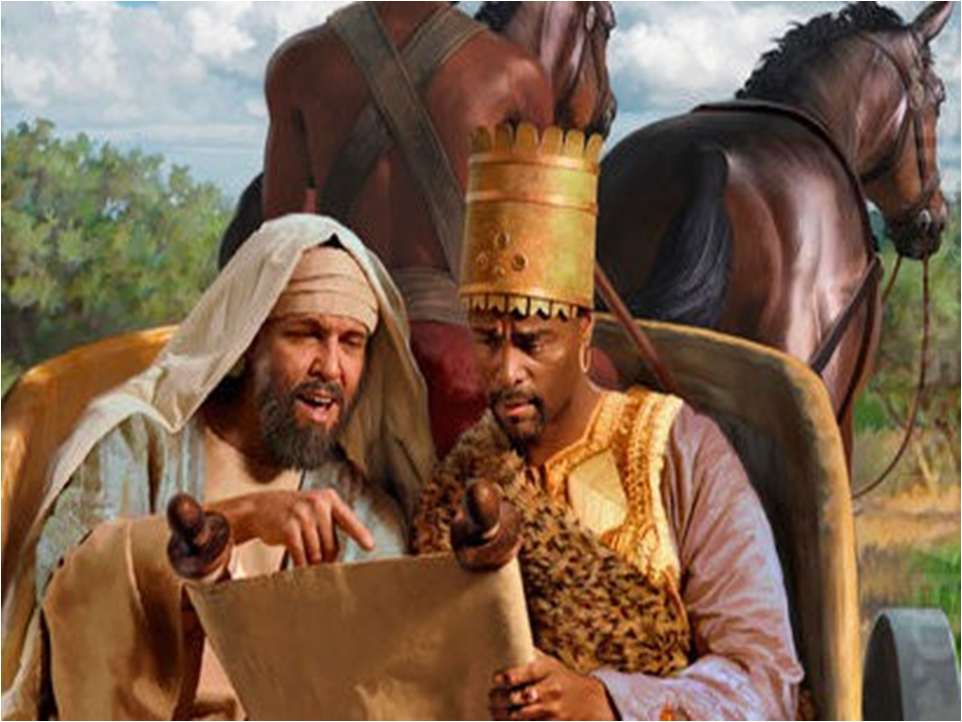
It so happened that an Ethiopian official was passing that way in his chariot. This man was the financial manager for Candace, queen of the Ethiopians, and he was on his way home after coming to Jerusalem to worship.

The Spirit said to Philip, “Run up alongside the chariot and listen.”

As Philip ran forward, he heard the man reading from the prophet Isaiah. So he said to the Ethiopian, “Do you understand what you are reading?”

The man replied, “Not really. I need someone to explain it.” Then he invited Philip to get in and sit by his side. The passage of Scripture he was reading was this: “He was led as a sheep to the slaughter, and like a lamb silent before its shearer, so He opened not His mouth. He was humiliated and denied justice. He was left with no descendants because they took His life.”

The official turned to Philip and said, “Can you tell me what this is about? Is Isaiah talking about himself or someone else?”

Starting with these verses, Philip told him the story of Jesus. Before long they came to a place where there was some water and the man said, “Look, here is water; is there any reason why I should not be baptized right now?”

He ordered the carriage to stop.  The two of them went down to the water and Philip baptized him. When they came up out of the water, the Spirit of the Lord took Philip away suddenly; the man never saw him again. He proceeded on his journey, his heart full of joy.

Philip found himself at Azotus. As he passed through the countryside, he went on telling the Good News in all the cities until he came to Caesarea.

The Sequel – Day 6

April 13, Monday

stoning-of-stephen-3Stephen, one of the seven chosen to serve the poor, was given unusual power and insights; and he performed miracles among the people. A number of devout Jews, from the synagogues of Cyrene and Alexandria and one known as the Libertines as well as some from Cilicia and Asia, tried to publicly debate Stephen; but they were no match for his wisdom nor the dominating presence of the Spirit. Desperate to silence Stephen, they bribed some men to testify against him by claiming that he was “blaspheming Moses and God.” They also stirred up the religious leaders and some in the crowds, who took hold of him and forcibly dragged him to where the Sanhedrin had gathered.

The false witnesses stated their charges: “This man is constantly speaking against this Holy Place and the Law. We even heard him say that Jesus of Nazareth will destroy this place and change the customs which Moses handed down to us.” As these claims were being made, everyone was staring at Stephen whose face had begun to radiate. Witnesses later said he took on the appearance of an angel.

Then the High Priest asked him, “Is what they’re saying true?”

And Stephen answered, “My brothers and my fathers, let me explain. As you know, our glorious God appeared to our forefather Abraham while he was in Mesopotamia before he ever came to live in Haran and said to him, ‘Get out of your country, away from your relatives, and come to a land that I will show you.’

“That is why he left the land of the Chaldeans and settled in Haran. After his father’s death God brought him into this very land where you are living today. God promised him that one day his descendants would settle here. This promise was given before Abraham had any children of his own.

“God also explained to Abraham that his offspring would first live as strangers and slaves in a foreign country for four hundred years. ‘Then I will judge that nation,’ said the Lord, ‘and will lead them safely out to serve Me in this Promised Land.’

“To further distinguish this emerging nation, God introduced the covenant of circumcision; and that is why, when Isaac was born, Abraham circumcised him on the eighth day. Isaac became the father of Jacob; and Jacob, the father of the twelve patriarchs.

“Then began a pattern of Israel rejecting God’s provision. You recall, don’t you, that the patriarchs, in their jealousy of Joseph, sold him as a slave into Egypt; but God was with him and eventually delivered him from all his troubles, giving him unusual wisdom and favor in the eyes of Pharaoh the king of Egypt. Pharaoh made him governor of Egypt and put him in charge of his entire household.

“Then, when the famine struck the region and our forefathers could find no food, Jacob sent our forefathers into Egypt where there was grain to be had. Later, on their second visit to Egypt, Joseph revealed his identity to his brothers and introduced them to Pharaoh. At Joseph’s invitation, Jacob and the entire clan of seventy-five moved to Egypt and lived out their days in that foreign land. When they died, their remains were brought back here to Shechem; they were laid in the tomb which Abraham had purchased from the sons of Hamor.

“As the time drew near for the fulfilment of God’s promise to Abraham, our people grew more and more numerous in Egypt. Eventually another king came to the Egyptian throne who knew nothing of Joseph. This man plotted against our people, forcing our forefathers to abandon their infant sons so that the race would be exterminated.

“That was when Moses was born. God looked upon him with great delight. For three months he was cared for in his own home.  Eventually his parents attempted to hide him. Pharaoh’s daughter found him, adopted him, and brought him up as her own son. This gave Moses access to the finest education and training. He gained a reputation as a compelling orator as well as a man of action.

“One day Moses, nearing forty years of age, decided it was time to visit his own brothers, the sons of Israel. When he saw one of them being treated harshly, he went to his defense and struck the Egyptian, killing him. In Moses’ mind, he saw this as the first step in his role as ‘God’s chosen Deliverer’; and he fully expected his Jewish brothers to rally behind his leadership. He was in for a rude awakening. The very next day he went to break up a fight between two Jewish workers. ‘Men, what are you doing?’ he asked. ‘No good can come of injuring each other; we need to work together.’

“But the man who was beating the other turned on Moses and pushed him away, saying, ‘Who do you think you are? What gives you any right to tell us what to do? I suppose you’re going to kill me like you did that Egyptian yesterday, aren’t you?’

That’s when Moses realized he was in trouble, so he fled to the land of Midian. While living in exile there, he became the father of two sons.

“Forty years later, in the desert of Mount Sinai, an angel appeared to him in the flames of a burning bush, much to Moses’ surprise. As he moved toward the bush to get a closer look, the voice of the Lord spoke to him, saying, ‘I am the God of your fathers — the God of Abraham, the God of Isaac, and the God of Jacob.’ Then Moses shook with fear; but the Lord spoke to him again and said, ‘Take your sandals off your feet, for the place where you stand is holy ground. I have certainly seen the oppression of My people who are in Egypt; I have heard their groaning and have come down to deliver them. Come now, I am sending you to Egypt.’

“It was this Moses . . .

  • who was rejected by his own people when they challenged him, saying, ‘Who made you a ruler and a judge?’
  • whom God had raised up to be their deliverer
  • to whom the angel of the Lord appeared in the bush
  • who performed mighty miracles in Egypt, at the Red Sea, and in the wilderness for forty years
  • who declared, ‘The Lord your God will raise up for you a Prophet like me from your brethren’
  • who stood between the congregation and the angel who spoke with him on Mt. Sinai
  • to whom was given the life-giving instructions of God for His people

“Yet it was our forefathers . . .

  • who turned their backs on Moses and turned a deaf ear to the words from God
  • whose hearts had turned back to Egypt
  • who encouraged Aaron to make a god who could lead them since Moses who had delivered them from Egypt was gone so long on the mountain
  • who fashioned a golden calf out of their own possessions and celebrated their accomplishment by offering sacrifices to it
  • who worshipped the stars of heaven rather than the Creator
  • who were confronted by God through the prophet Amos: ‘Was it to My tabernacle you brought all those sacrifices during the forty years in the wilderness? No, you were, in your hearts, offering them up to the tabernacle of Moloch and the star god, Remphan. Therefore I will take you away from this land into Babylon.’

“Even though they had the tabernacle of God . . .

  • which was built according to the precise design which God had given to Moses
  • which was carried into this land by our forefathers as God drove out the Gentiles under Joshua
  • which was where Israel met with God right up to the time of David
  • which was replaced by Solomon’s temple after David prayed that he might establish a permanent dwelling-place for the God of Jacob. Of course we know that the Most High cannot be contained in anything built by human hands as the prophet Isaiah recorded: ‘Heaven is My throne and the earth is My footstool. What kind of house could you build to accommodate Me? Did I not make all these things with My own hands?’

“What is the point of all this? You stubborn people are every bit as bad as your fathers: you constantly resist God’s Spirit, refusing to listen to Him or let Him change your hearts. Can you name any prophets whom your fathers didn’t persecute? Indeed, they killed anyone who foretold the coming of the Messiah; and now you have betrayed and killed the Righteous One. You had God’s Law handed to you by angels and look what you’ve done with it!”

These concluding remarks infuriated the Council and they gnashed their teeth in anger. Stephen, however, being filled with the Holy Spirit, was given a vision of heaven as he gazed skyward. “Oh, look!” he exclaimed, “the heavens are open, and I can see the Son of Man standing at God’s right hand!”

That was the last straw. The people, plugging their ears and shouting to drown out Stephen’s words, grabbed him and dragged him outside the city walls where they began hurling stones upon him. One of the younger Pharisees, a man named Saul, was in hearty agreement with the proceedings. Many, hurrying to participate, left their outer garments in Saul’s charge.

As the rocks flew, Stephen called out, “Lord Jesus, receive my spirit!” Then, falling to his knees, he cried out with a loud voice, “Lord, do not hold this sin against them!” Having said that, he collapsed in the sleep of death, the church’s first martyr. A handful of devout believers took Stephen’s body and buried it with much loud mourning and weeping.

This event touched off a wave of persecution against the church in Jerusalem. The believers, except for the apostles, were forced to flee to the outlying areas of Judea and Samaria. Saul, like a man possessed, ravaged the church as he went from house to house dragging out men and women and throwing them into prison.

The Sequel – Day 5

April 12, Sunday

GamalielWhat unforgettable days those were. There were so many gathering together that they decided to meet regularly in Solomon’s Porch. They gained the respect of the public at large, but fear prevented casual onlookers from joining out of curiosity. Still, large numbers of men and women believed and the congregation multiplied.

With reports of ongoing miracles, many brought their sick into the streets and laid them down on mats so that Peter’s shadow might fall upon some of them. A steady flow of people from outlying villages brought their sick or demonized loved ones, and they were all cured.

________________

This was too much for the High Priest and the Sadducees. Jealous of the popularity of this new movement, they had the apostles arrested and put in jail.

But during the night an angel of the Lord opened the prison doors and led them out, saying, “Go, stand and speak in the Temple. Tell the people the whole Message about this new life!”

So early the next morning they entered the Temple and began to teach. Meanwhile, the High Priest convened the Sanhedrin and the whole senate of the people of Israel. He then sent word to the jail to have the apostles brought in. Of course, when the officers arrived at the prison, they could not find them there. They came back with this report: “We found the prison securely locked and the guard standing on duty at the doors; but when we opened up, we found no one inside.”

When the captain of the Temple guard and the chief priests heard their report, they were extremely troubled and wondered what on earth would happen next. Just then someone arrived and reported to them, “Did you know that the men you put in jail are back in the Temple teaching again?”

The captain and officers proceeded to the Temple to apprehend them yet again. They knew they couldn’t use force lest the masses should stone them. The apostles complied and willingly took their stand before the Sanhedrin. The High Priest addressed them, saying, “We gave you the strictest possible orders to stop teaching in this Name. Now look what you’ve done — you have filled Jerusalem with your teaching, and we understand that you are saying we’re responsible for this Man’s blood!”

Peter and the apostles answered him, “We simply must obey God rather than men. We’re talking about the same God Whom our fathers worshipped. He raised Jesus to life after you murdered Him on that cross. Not only did God resurrect Him, He then gave Him the seat of honor as Prince and Conqueror at His right hand. He did all this to make it possible for His people Israel to repent and receive the forgiveness of their sins. We aren’t making this up; we are eye-witnesses of the whole thing. God’s Spirit, given to anyone who embraces the Message, also bears witness to the truth of our testimony.”

This mini-sermon didn’t set well with the council. In fact, they were so furious they wanted to kill the apostles on the spot. Gamaliel, a Pharisee and senior member of the Council, highly respected by all, ordered that the apostles be taken out of the room for a few minutes.

Then he addressed the assembly: “Men of Israel, be careful how you handle this! Let me remind you of a couple similar situations in recent years. Do you recall that fellow named Theudas who made some outlandish claims and succeeded in rallying about four hundred men to follow him? Once he was killed, all his followers dispersed and the movement came to nothing. After that, in the days of the census, a Galilean named Judas showed up and enticed a bunch of people to follow him. But he too died and his whole following scattered. That’s why I think we should just leave this group alone. If their teaching or movement is merely human, it will dissolve in time; but if it should be from God, you can’t stop them. What’s worse, you might find that you’ve been fighting against God!”

They group agreed to his advice and called in the apostles. They had them flogged; and after commanding them not to speak in the name of Jesus, let them go.

The apostles left the proceeding, rejoicing that they been given the privilege of suffering for “The Name.” Every day they went to the Temple and from house to house boldly proclaiming that Jesus was the Messiah.

________________

As thrilling as the massive influx of new believers was, it created a challenge for the apostles as they attempted to meet the needs of so many. When a complaint surfaced that Jewish widows were being given preferential treatment while the Gentiles widows were being slighted, the Twelve realized that they couldn’t attend to all these needs and still keep up with their teaching opportunities. So they called the group together and said, “We’re finding that managing the benevolence fund is keeping us from proclaiming the Word of God. Something has to be done. We’d like you to look around and pick out from among yourselves seven men of good reputation who are known for their wisdom and who are filled with God’s Spirit. We will put them in charge of this matter. Then we’ll be able to devote ourselves to prayer and the ministry of the Word.”

The whole congregation agreed. After discussion, they chose Stephen, a man known for trusting and walking in the power of the Holy Spirit; Philip; Prochurus; Nicanor; Timon; Parmenas; and Nicolas of Antioch, a former convert to the Jewish faith. They set these men before the apostles, who, after prayer, laid their hands upon them, commissioning them to this vital ministry.

The Word of God spread further and faster. A large number of priests accepted the Message and the number of disciples in Jerusalem increased rapidly.

The Sequel – Day 4

April 11, Saturday

(c) Royal Academy of Arts; Supplied by The Public Catalogue FoundationThe next day Jesus’ apostles were questioned by the leading members of the council. The elders and scribes were there along with Annas the High Priest, Caiaphas, John, Alexander, and the whole of the High Priest’s family. “Who gave you authority and where did you get the power to heal this man?” they asked.

Peter, filled with the Holy Spirit, responded by saying, “Leaders of the people and elders, apparently we are being interrogated today because of a kindness done to this handicapped man. You want to know how he was healed. Well, it is high time that all of you and the entire nation of Israel knew that it was done in the name of Jesus Christ of Nazareth — yes, the very One Whom you crucified but Whom God raised from the dead! It is by His power that this man stands here perfectly restored. Jesus Christ, the ‘stone rejected by you builders has become the Chief Cornerstone.’  The fact is that He alone can rescue men from their helpless condition; in His Name alone is there any hope of deliverance.”

The Council was thrown off-guard by the boldness and competence of Peter and John, mere fishermen who were obviously uneducated and untrained. They recognized them as men who had traveled with Jesus. Because the man who had been cured was standing right there, they didn’t know what to do.  So they ordered them out of the Sanhedrin in order to discuss it among themselves.

“What are we going to do with these men?” they asked each other. “Everyone in Jerusalem knows that they’ve performed this miracle, and there’s nothing we can do about it. But we’ve got to do something to prevent any more of this kind of thing. Let’s warn them not to say anything more to anyone in this Name or there will be severe consequences.”

The disciples were called back in and commanded not to speak one more word about the name of Jesus, but Peter and John weren’t about to be swayed by their threats. “You’re going to have to decide,” they answered, “whether it is right in the eyes of God for us to obey what you say rather than what He says. We cannot help talking about our experience!”

All that the Council could do at that point was to threaten them because the people were thrilled with the healing of this poor man who had suffered for over forty years. Everyone was praising God! Everyone, that is, except for the Jewish religious leaders.

Immediately upon being released, the two apostles went back to their friends and reported to them what the chief priests and elders had said. You might think that some would have been frightened, but just listen to what they did. Upon hearing the report, the believers raised their voices in prayer: “Ah, Lord God, Maker of heaven and earth and the sea and all that is in them, You are not moved by the futile threats of men!

“You declared through Your servant David in Psalm 2, ‘Why do the nations rage and the people waste their time with futile plans? The kings and rulers of the earth conspire together against the Lord and against His Christ.’

“Yes, that is what happened to Your holy servant Jesus Whom You anointed. Herod and Pontius Pilate along with the Gentiles and the people of Israel all gathered together to accomplish precisely what Your hand and Your purpose determined beforehand had to be done. Now, Sovereign Lord, You have heard their threats. Would You give us, your servants, fresh boldness to declare Your Word? Would You confirm the Message by stretching out Your hand to heal? Grant that mighty signs and wonders may be done through the Name of Your holy servant Jesus.”

And God responded. When they finished praying, the meeting-place was shaken; they were all filled with the Holy Spirit and spoke the Word of God fearlessly. The apostles testified forcefully as they proclaimed the resurrection of the Lord Jesus.

________________

An extraordinary unity and love pervaded the large group of Christ-followers. They were so focused on one purpose that they willingly shared all their possessions in common. Such a spirit of generosity existed that no one experienced need. Any who owned property sold it and brought the proceeds to the apostles for them to distribute as needed.

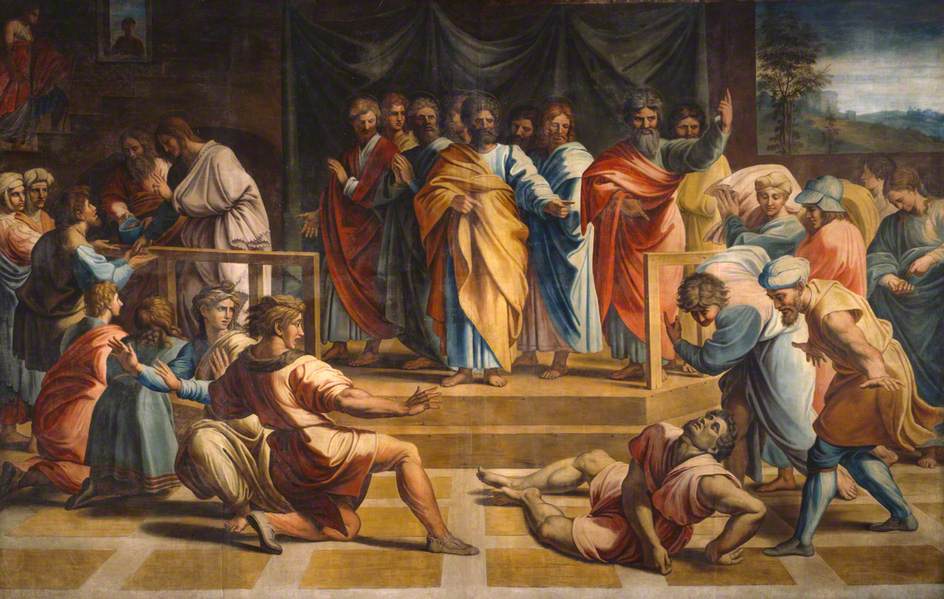
One brother by the name of Barnabas sold his farm and brought the money to the apostles. Another couple, Ananias and Sapphira, wanting to give the impression that they were just as generous, sold their property but kept back part of the proceeds for their own use, pretending they were giving it all. However, when he brought the money to Peter, Peter confronted him, saying, “Ananias, how is it that Satan has convinced you to cheat the Holy Spirit and keep back for yourself part of the price of the land? Before the land was sold, it was yours; and after the sale you were free to do whatever you pleased with the money. What has come over you? You have not lied to men, but to God!”

Upon hearing Peter’s words, Ananias collapsed and died. Fear struck everyone in the room. Some young men got to their feet and after wrapping up his body carried him out and buried him. About three hours later Ananias’ wife came in not knowing what had taken place. Peter spoke directly to her, “Tell me, did you sell your land for so much?”

“Yes,” she answered, “that was the price.”

Then Peter said to her, “How could the two of you have agreed to test the Spirit of the Lord like this? Listen, I hear the footsteps of the men who have just buried your husband coming back through the door. Now they will carry you out.” Immediately she collapsed and died. When the young men came into the room, they saw her lying dead at Peter’s feet. They carried her out and buried her beside her husband. The whole community of believers, indeed everyone who heard about it, was filled with holy fear.