Unknown's avatar

Posts by jdansmall

I'm a beggar on the trail looking for and sharing "bread crumbs" to make the journey better for all of us!

The Sequel – Day 9

April 16, Thursday

Peters VisionNow Peter, in the course of his travels, came to visit the believers in Lydda. There he found a man named Aeneas who had been paralyzed and bed-ridden for eight years. Peter said to him “Aeneas, Jesus Christ heals you! Get up and roll up your bed.”

He got to his feet at once. This miracle caused a major revival.  Everyone living in Lydda and Sharon turned to the Lord when they heard about it.

Meanwhile in Joppa a disciple by the name of Tabitha became very sick and died. She was deeply loved for her life had been fully devoted to serving others and helping the poor. They washed her body and laid her in an upper room. Now Lydda is quite near Joppa.  So when the disciples heard that Peter was in Lydda, they sent two men to him and begged him, “Please come quickly!”

Peter hurried back with them. When he arrived in Joppa, they took him to the room where she lay. With much weeping, the gathered mourners showed Peter all the dresses and cloaks which she had made for them. Peter asked everyone to leave the room, and he knelt down and prayed. Then he turned to the body and said, “Tabitha, get up!”

She opened her eyes.  As soon as she saw Peter she sat up. He took her by the hand, helped her to her feet, and then called out to the believers and widows, presenting her to them alive. Here, as in Lydda, the miracle became known and many believed in the Lord. Peter himself remained there for some time, residing in the home of a tanner named Simon.

________________

Some distance north of Joppa, in Caesarea, lived a man by the name of Cornelius, a centurion in what was called the Italian Regiment. He and his entire household were known for their devout reverence for God. He cared for the poor and was a real man of prayer. About three o’clock one afternoon an angel of God appeared to him in a vision. As the angel approached him, he called him by name, “Cornelius!”

Shaking with fear, Cornelius replied, “Yes, sir?”

The angel went on, “God has heard your prayers and seen your deeds of charity. Now send men to Joppa for a man called Simon, who is also known as Peter. He is staying as a guest with another Simon, a tanner, whose house is down by the sea.”

Immediately, when the angel had gone, Cornelius called for two of his house-servants and a devout soldier who was one of his personal attendants. He told them the whole story and then sent them off to Joppa.

On the following day as the group was nearing Joppa, Peter had gone up to the roof-top deck to pray. He became quite hungry and asked for some lunch. While it was being prepared, he fell into a trance and had a vision of the sky opening and a great sheet, held at its corners, descending to where he was. On the sheet were all manner of animals, reptiles, and birds. Then Peter heard a voice, saying, “Get up, Peter, kill and eat!”

It so happened that all the creatures were things God’s Law given in the Old Testament had forbidden His people to eat. Repulsed by the idea, Peter said, “Never, Lord! For not once in my life have I ever eaten anything common or unclean.”

Then the voice spoke to him a second time, “You must not call unclean what God has cleansed.”

Three times the vision was repeated before being taken back into heaven. While Peter was still trying to figure out what the vision meant, the men sent by Cornelius had arrived and were standing at the very doorway of the house, calling out to enquire if Simon, surnamed Peter, was staying there. Peter was lost in his thoughts when the Spirit said to him, “Three men are here looking for you. Get up and go downstairs. Don’t hesitate to go with them because I Myself have sent them to you.”

So Peter went down to the men and said, “I believe you are looking for me; what can I do for you?”

They replied, “Cornelius the centurion, an upright and God-fearing man, who is loved and respected by all the Jews, was commanded by a holy angel to send for you to come to his house that he might hear your Message.”

Peter invited them in and they spent the night there. Early the next morning, accompanied by some of the brothers from Joppa, Peter set out for Caesarea, arriving on the following day. Cornelius was waiting anxiously for them and had gathered together all his relations and close friends. When Peter arrived at the house, Cornelius fell on his knees before him and began worshipping him. But Peter helped him to his feet and said, “Stand up, I am just a man like you!”

Upon entering the house, Peter found that a large number of people had assembled. He began by explaining, “You all know that it is forbidden for a Jew to associate with or enter the home of a non-Jew. But God has shown me plainly that no man must be called ‘common’ or ‘unclean.’ That is why I came here without hesitation. Now tell me your side of the story.”

Cornelius said, “Four days ago, about this time, I was observing the afternoon hour of prayer in my house when suddenly a man in shining clothes stood before me and said, ‘Cornelius, your prayer has been heard and your charitable gifts have been remembered before God. Now send to Joppa and invite here a man called Simon Peter. He is staying in the house of a tanner by the name of Simon, down by the sea.’ So I sent to you without delay and you have been most kind in coming. Now we are all here in the presence of God to listen to everything that the Lord has commanded you to say.”

Then Peter began to speak, “This is most remarkable! God is showing us that He is no respecter of persons, but that He welcomes those from every nation who reverence Him and do what is right. Here is the Message God sent first to the sons of Israel: the Good News of peace through Jesus Christ, Who is Lord of us all. You have heard the story of Jesus of Nazareth, haven’t you? Everyone around here has!

  • “It began in Galilee where He was baptized by John.
  • “Then God anointed Him with the power of the Holy Spirit.
  • “From there He went about doing good and healing all who were oppressed by the devil.
  • “God was clearly working through Him; and we were right there with Him, eyewitnesses of everything, from the villages to Jerusalem.
  • “But they murdered Him, hanging Him on a cross.
  • “On the third day God raised Him up, but not everyone could see Him. God caused Him to be visible to many of us whom He had chosen to be His witnesses.
  • “Indeed, we ate and drank with Him after His resurrection.
  • “Then Jesus instructed us to spread the Good News everywhere, explaining that He is the One Whom God appointed as Judge of both the living and the dead.
  • “The prophets of old all pointed to Him, making it clear that everyone who believes in Him receives forgiveness of their sins through His Name.”

Even as Peter was saying these words, the Holy Spirit fell upon all who were listening to his message. The Jewish believers who had come with Peter were astonished that the gift of the Holy Spirit was being poured out on Gentiles also, for they heard them speaking in unusual tongues and glorifying God.

Then Peter exclaimed, “Well, since these men have received the Holy Spirit just as we ourselves did, what’s to prevent us from baptizing them?” So he gave orders for them to be baptized in the name of Jesus Christ. At their request Peter stayed with them for several days.

The Sequel – Day 8

April 15, Wednesday

Saul DamascusMeanwhile, back in Jerusalem, Saul continued his rampage against the Lord’s disciples. Knowing that the Message was spreading, he obtained letters from the High Priest authorizing him to investigate the synagogues in Damascus. His plan was to arrest any followers of the Way, men or women, and haul them back to Jerusalem as prisoners.

Somewhere along the way everything changed. They were not far from Damascus when a blinding light, like lightning, blazed around him and he fell to the ground. Then he heard a voice speaking to him, “Saul, Saul, why are you persecuting Me?”

“Who are You, Lord?” he asked.

“I am Jesus Whom you are persecuting,” was the reply. “But now stand up and go into the city. There you will be told what you must do.”

The rest of the entourage stood there in stunned silence. They too had heard the voice but couldn’t see who was speaking. Saul got up from the ground; but when he opened his eyes, he couldn’t see anything. His companions took him by the hand and led him on into Damascus where he remained sightless for three days. During that time he fasted, having nothing to eat or drink.

One of Jesus’ followers by the name of Ananias lived in Damascus. The Lord appeared to him in a dream and called him by name. “I am here, Lord,” he replied.

Then the Lord said to him, “Get up and go down to Straight Street to the house of Judas. Ask there for a man named Saul from Tarsus. Saul is praying; and I have given him a vision of a man by the name of Ananias coming into the house, placing his hands upon him, and restoring his sight.”

But Ananias replied, “Lord, I have heard about him and all the trouble he has caused the believers in Jerusalem! We’ve heard that he has permission from the chief priests to arrest every one of us who call on Your Name.”

But the Lord said to him, “Go! I have chosen him to be the one who will take My Name to the Gentiles and their kings, as well as to the sons of Israel. And I will show him how much suffering he will endure for My Name’s sake.”

So Ananias made his way to the house. There he laid his hands upon Saul, saying, “Brother Saul, the Lord Jesus, who appeared to you, has sent me here so that your sight may be restored and that you may be filled with the Holy Spirit.”

Immediately something like scales fell from Saul’s eyes and he could see again. He got to his feet and was baptized. After eating a meal, he regained his strength. Saul stayed in Damascus for some time, fellowshipping with the believers and preaching in all the synagogues that Jesus is the Son of God. The Jewish congregation was dumbfounded, saying to one another, “Isn’t this the guy who fought so hard against the Name in Jerusalem?  Didn’t he come here to arrest all who identify with Jesus and take them back the chief priests?” But Saul became increasingly effective in proving that Jesus was the Messiah. The Jews living in Damascus could not refute his claim.

After several days of this the Jews plotted to kill Saul, but he got wind of it and made plans to leave. Guards watched the gates of the city day and night to prevent his escape; so he got some of his disciples to let him down through an opening in the wall, lowering him in a large basket.

Saul returned to Jerusalem and tried to join the disciples, but they were all afraid of him. They couldn’t believe his claim to be a disciple. Barnabas, however, believed him and introduced him to the apostles. He spoke in Saul’s defense, explaining that Saul had seen the Lord on his journey, that the Lord had spoken to him, and that he had spoken in Damascus with great boldness in the Name of Jesus. From that point on, Saul worked alongside them in Jerusalem, preaching fearlessly in the name of the Lord. He used to debate with the Greek-speaking Jews until they made several attempts on his life. Finally the threats prompted the brothers to take Saul to Caesarea and send him off to Tarsus.

Thus began a season of relative peace for the church as it became established throughout the region. The number of believers increased, and they continued in great reverence for the Lord and enjoyed the companionship of the Holy Spirit.

By What Manner of Death

No matter how you slice it, death stinks!  Or, as Scripture says, “Death stings!”  The human psyche is repulsed by it, yet it is one of the unavoidable universal experiences common to every living, breathing being.

The fact that we spend much of our lives in denial of mortality and sometimes spend our fortunes trying to postpone the inevitable suggests that perhaps it isn’t what we were originally intended for.  The futile search for the “fountain of youth” is more than a fairy tale. It is, in some sense, a striving to recover our primal design.

The fact of the matter is that if you were to reduce the Bible (God’s design manual) to the first two chapters of Genesis and the last two chapters of Revelation, you would discover a world without death, a world in which life pulsed in every atom of the universe.  Also, if you were to focus on the life/death issue as addressed by Jesus (God in human flesh), you would see a Message intent on life, a death-conquering life.

Jesus declared, “I came so that they could have life – yes, and have it full to overflowing.”  The most famous Scripture reference, John 3:16, targets this issue head-on: “For God so loved the world that He gave His only begotten Son, that whosoever believeth in Him should not perish but have everlasting life.

The apostle Paul was inspired by God to declare that death was, in fact, the last enemy to be destroyed (1 Cor 15).  Romans 6:23 confirms what Genesis 3 described: death is the direct consequence of sin.  So it is evident that death (and the ills that lead up to it) is not what our Maker meant for us.

In light of all this, what should the attitude of a follower of Christ be toward death?  It’s one thing to celebrate the promise of “eternal life,” but quite another to face the grinding, debilitating, all-consuming onset of death in our bodies (or those of loved ones).  We read of miraculous “resurrections” in the Bible and even down through history as God intervened by raising up one who was clearly dead.  But we must quickly point out that these “healings” were merely temporary as every person (i.e., Lazarus and Tabitha) had to face death again at some point.  Only Jesus Christ experienced a permanent resurrection, which, by the way, He promised to all who follow Him.

This brings us to the strange statement John made in the final story recorded in his gospel.  Jesus and the disciples have just finished a “men’s breakfast” beside Galilee.  Jesus pulls Peter aside to commission him as a shepherd of Jesus’ “flock.”  Then He gives Peter a heads-up about the end of his life when He says, “… when you are old, you’ll stretch out your hands, and someone else will dress you up and take you where you don’t want to go.”  By way of explanation, John says, “He said this to indicate the sort of death by which Peter would bring God glory.”

In what amounts to an aside in the grand story of Jesus, we are handed this new pair of glasses – a very different way to see death, “by which Peter would bring God glory.”  Suddenly everything looks different.  Jesus’ own gruesome death wasn’t an unfortunate tragedy, it was a carefully planned means of “bringing God glory.”  Stephen, the Church’s first martyr, sees glory as the stones crush his life out of him, and a collaborator in his murder, Saul, witnesses first-hand a death “bringing glory to God.”

Saul, renamed Paul, would later write concerning his own life, “Christ will even now, as always, be exalted in my body, whether by life or by death.”  Then, after years of history-making service, Paul writes biographically, “. . . the strategic time of my departure is already present. The desperate, straining, agonizing contest marked by its beauty of technique, I like a wrestler have fought to the finish, and at present am resting in its victory. My race, I like a runner have finished, and at present am resting at the goal. The Faith committed to my care, I like a soldier have kept safely through everlasting vigilance, and have delivered it again to my Captain.” 1 Timothy 4 (Wuest tr.)

Taking our cues from David in Psalm 23, those who have made the Lord their Shepherd can pass through the valley of the shadow of death without fear.  Some, like Stephen in Acts 7, find themselves suddenly translated to Glory while in the prime of life, while others live well into their eighties and nineties.  Those of us who get a terminal prognosis “prematurely” are tempted, like Peter, to ask “what about so-and-so?”  That question is always met with the same question Jesus posed to Peter, “If I want him/them to live forever, what is that to you?”  Bottom line: we must live our life, not someone else’s.

Where do you find yourself today?  Have the doctors given up on you?  Maybe you’ve been given six months or a year, what do you do with that?  Perhaps it is a loved one who is facing death.  Take heart, this too can bring glory to God.  Let that vision settle into your innermost spirit.  Thank God that “whether by life or by death” you know that “goodness and mercy will follow you ALL the days of your life and you will dwell in the house of the Lord forever.”

J. Dan Small
April 13, 2015

The Sequel – Day 7

April 14, Tuesday

philip ethiopianAll this did nothing to stop the Message. All who had been scattered began spreading the good news everywhere they went. Philip, another of the Seven chosen to help the apostles along with Stephen, found himself in the city of Samaria. As he told the story of Jesus, large crowds listened and watched as evil spirits were cast out and the lame and paralyzed were cured. The whole city was buzzing with excitement.

One of the town’s notorieties was a man named Simon, a sorcerer who had impressed the people with his magic acts. People called him “the Great Power of God.” As the multitudes heard Philip’s message about the Kingdom of God and saw what was done in the name of Jesus Christ, they embraced it and were baptized into the new faith. Simon too believed and was baptized. Then he stayed alongside Philip to see first-hand all the remarkable miracles. He was fascinated by it.

When the apostles in Jerusalem heard reports that Samaria had accepted the Word of God, they sent Peter and John down to check it out. The first thing they did upon arriving was to ask the Lord to pour out His Spirit on them as they had only been baptized in the name of the Lord Jesus. When the apostles laid their hands on the new believers, they received the Spirit. Simon, seeing this phenomenon, offered the apostles some money, saying, “I’d like to have the power you have to give the Holy Spirit to people by laying hands on them.”

But Peter said to him, “What are you thinking? If you believe for a moment that you can buy God’s gifts, you are in no position to be ministering to others. Your heart is in the wrong place; both you and your money will be destroyed. I can see that you are motivated by jealousy and are full of yourself. You’d better get your thinking turned around and beg God’s forgiveness for this sin.”

Simon answered humbly, “Oh, please pray to the Lord for me that this won’t happen to me!”

The apostles and Philip spent some time explaining the Message more fully before returning to Jerusalem. Along the way they presented the Good News to many Samaritan villages.

________________

But an angel of the Lord said to Philip, “Get up and go down the road which runs from Jerusalem to Gaza out in the desert.” So Philip headed south.

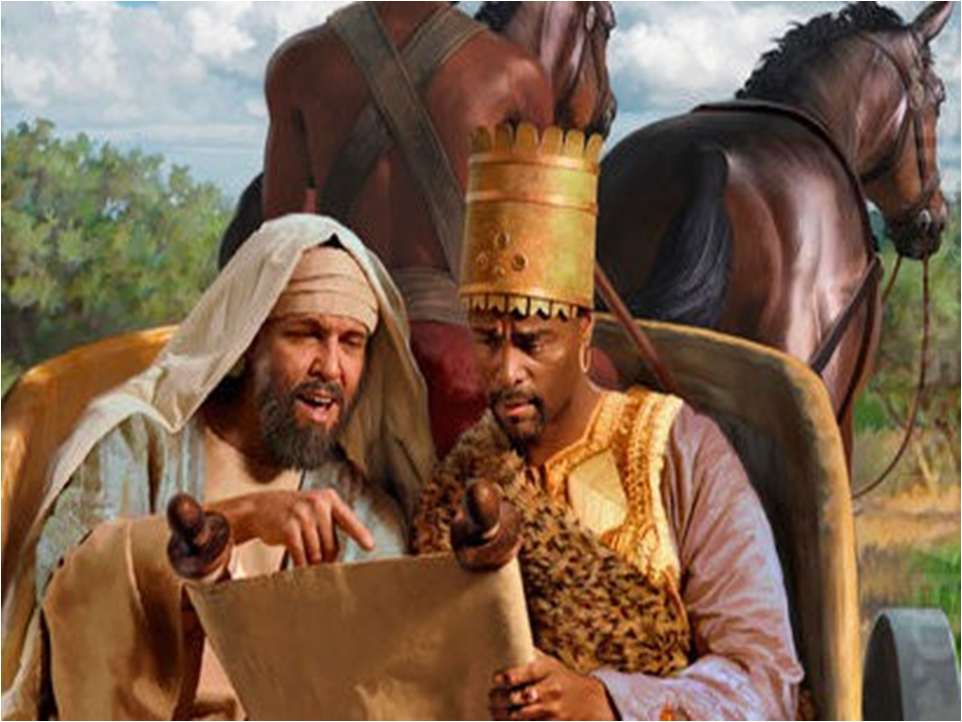
It so happened that an Ethiopian official was passing that way in his chariot. This man was the financial manager for Candace, queen of the Ethiopians, and he was on his way home after coming to Jerusalem to worship.

The Spirit said to Philip, “Run up alongside the chariot and listen.”

As Philip ran forward, he heard the man reading from the prophet Isaiah. So he said to the Ethiopian, “Do you understand what you are reading?”

The man replied, “Not really. I need someone to explain it.” Then he invited Philip to get in and sit by his side. The passage of Scripture he was reading was this: “He was led as a sheep to the slaughter, and like a lamb silent before its shearer, so He opened not His mouth. He was humiliated and denied justice. He was left with no descendants because they took His life.”

The official turned to Philip and said, “Can you tell me what this is about? Is Isaiah talking about himself or someone else?”

Starting with these verses, Philip told him the story of Jesus. Before long they came to a place where there was some water and the man said, “Look, here is water; is there any reason why I should not be baptized right now?”

He ordered the carriage to stop.  The two of them went down to the water and Philip baptized him. When they came up out of the water, the Spirit of the Lord took Philip away suddenly; the man never saw him again. He proceeded on his journey, his heart full of joy.

Philip found himself at Azotus. As he passed through the countryside, he went on telling the Good News in all the cities until he came to Caesarea.

The Sequel – Day 6

April 13, Monday

stoning-of-stephen-3Stephen, one of the seven chosen to serve the poor, was given unusual power and insights; and he performed miracles among the people. A number of devout Jews, from the synagogues of Cyrene and Alexandria and one known as the Libertines as well as some from Cilicia and Asia, tried to publicly debate Stephen; but they were no match for his wisdom nor the dominating presence of the Spirit. Desperate to silence Stephen, they bribed some men to testify against him by claiming that he was “blaspheming Moses and God.” They also stirred up the religious leaders and some in the crowds, who took hold of him and forcibly dragged him to where the Sanhedrin had gathered.

The false witnesses stated their charges: “This man is constantly speaking against this Holy Place and the Law. We even heard him say that Jesus of Nazareth will destroy this place and change the customs which Moses handed down to us.” As these claims were being made, everyone was staring at Stephen whose face had begun to radiate. Witnesses later said he took on the appearance of an angel.

Then the High Priest asked him, “Is what they’re saying true?”

And Stephen answered, “My brothers and my fathers, let me explain. As you know, our glorious God appeared to our forefather Abraham while he was in Mesopotamia before he ever came to live in Haran and said to him, ‘Get out of your country, away from your relatives, and come to a land that I will show you.’

“That is why he left the land of the Chaldeans and settled in Haran. After his father’s death God brought him into this very land where you are living today. God promised him that one day his descendants would settle here. This promise was given before Abraham had any children of his own.

“God also explained to Abraham that his offspring would first live as strangers and slaves in a foreign country for four hundred years. ‘Then I will judge that nation,’ said the Lord, ‘and will lead them safely out to serve Me in this Promised Land.’

“To further distinguish this emerging nation, God introduced the covenant of circumcision; and that is why, when Isaac was born, Abraham circumcised him on the eighth day. Isaac became the father of Jacob; and Jacob, the father of the twelve patriarchs.

“Then began a pattern of Israel rejecting God’s provision. You recall, don’t you, that the patriarchs, in their jealousy of Joseph, sold him as a slave into Egypt; but God was with him and eventually delivered him from all his troubles, giving him unusual wisdom and favor in the eyes of Pharaoh the king of Egypt. Pharaoh made him governor of Egypt and put him in charge of his entire household.

“Then, when the famine struck the region and our forefathers could find no food, Jacob sent our forefathers into Egypt where there was grain to be had. Later, on their second visit to Egypt, Joseph revealed his identity to his brothers and introduced them to Pharaoh. At Joseph’s invitation, Jacob and the entire clan of seventy-five moved to Egypt and lived out their days in that foreign land. When they died, their remains were brought back here to Shechem; they were laid in the tomb which Abraham had purchased from the sons of Hamor.

“As the time drew near for the fulfilment of God’s promise to Abraham, our people grew more and more numerous in Egypt. Eventually another king came to the Egyptian throne who knew nothing of Joseph. This man plotted against our people, forcing our forefathers to abandon their infant sons so that the race would be exterminated.

“That was when Moses was born. God looked upon him with great delight. For three months he was cared for in his own home.  Eventually his parents attempted to hide him. Pharaoh’s daughter found him, adopted him, and brought him up as her own son. This gave Moses access to the finest education and training. He gained a reputation as a compelling orator as well as a man of action.

“One day Moses, nearing forty years of age, decided it was time to visit his own brothers, the sons of Israel. When he saw one of them being treated harshly, he went to his defense and struck the Egyptian, killing him. In Moses’ mind, he saw this as the first step in his role as ‘God’s chosen Deliverer’; and he fully expected his Jewish brothers to rally behind his leadership. He was in for a rude awakening. The very next day he went to break up a fight between two Jewish workers. ‘Men, what are you doing?’ he asked. ‘No good can come of injuring each other; we need to work together.’

“But the man who was beating the other turned on Moses and pushed him away, saying, ‘Who do you think you are? What gives you any right to tell us what to do? I suppose you’re going to kill me like you did that Egyptian yesterday, aren’t you?’

That’s when Moses realized he was in trouble, so he fled to the land of Midian. While living in exile there, he became the father of two sons.

“Forty years later, in the desert of Mount Sinai, an angel appeared to him in the flames of a burning bush, much to Moses’ surprise. As he moved toward the bush to get a closer look, the voice of the Lord spoke to him, saying, ‘I am the God of your fathers — the God of Abraham, the God of Isaac, and the God of Jacob.’ Then Moses shook with fear; but the Lord spoke to him again and said, ‘Take your sandals off your feet, for the place where you stand is holy ground. I have certainly seen the oppression of My people who are in Egypt; I have heard their groaning and have come down to deliver them. Come now, I am sending you to Egypt.’

“It was this Moses . . .

  • who was rejected by his own people when they challenged him, saying, ‘Who made you a ruler and a judge?’
  • whom God had raised up to be their deliverer
  • to whom the angel of the Lord appeared in the bush
  • who performed mighty miracles in Egypt, at the Red Sea, and in the wilderness for forty years
  • who declared, ‘The Lord your God will raise up for you a Prophet like me from your brethren’
  • who stood between the congregation and the angel who spoke with him on Mt. Sinai
  • to whom was given the life-giving instructions of God for His people

“Yet it was our forefathers . . .

  • who turned their backs on Moses and turned a deaf ear to the words from God
  • whose hearts had turned back to Egypt
  • who encouraged Aaron to make a god who could lead them since Moses who had delivered them from Egypt was gone so long on the mountain
  • who fashioned a golden calf out of their own possessions and celebrated their accomplishment by offering sacrifices to it
  • who worshipped the stars of heaven rather than the Creator
  • who were confronted by God through the prophet Amos: ‘Was it to My tabernacle you brought all those sacrifices during the forty years in the wilderness? No, you were, in your hearts, offering them up to the tabernacle of Moloch and the star god, Remphan. Therefore I will take you away from this land into Babylon.’

“Even though they had the tabernacle of God . . .

  • which was built according to the precise design which God had given to Moses
  • which was carried into this land by our forefathers as God drove out the Gentiles under Joshua
  • which was where Israel met with God right up to the time of David
  • which was replaced by Solomon’s temple after David prayed that he might establish a permanent dwelling-place for the God of Jacob. Of course we know that the Most High cannot be contained in anything built by human hands as the prophet Isaiah recorded: ‘Heaven is My throne and the earth is My footstool. What kind of house could you build to accommodate Me? Did I not make all these things with My own hands?’

“What is the point of all this? You stubborn people are every bit as bad as your fathers: you constantly resist God’s Spirit, refusing to listen to Him or let Him change your hearts. Can you name any prophets whom your fathers didn’t persecute? Indeed, they killed anyone who foretold the coming of the Messiah; and now you have betrayed and killed the Righteous One. You had God’s Law handed to you by angels and look what you’ve done with it!”

These concluding remarks infuriated the Council and they gnashed their teeth in anger. Stephen, however, being filled with the Holy Spirit, was given a vision of heaven as he gazed skyward. “Oh, look!” he exclaimed, “the heavens are open, and I can see the Son of Man standing at God’s right hand!”

That was the last straw. The people, plugging their ears and shouting to drown out Stephen’s words, grabbed him and dragged him outside the city walls where they began hurling stones upon him. One of the younger Pharisees, a man named Saul, was in hearty agreement with the proceedings. Many, hurrying to participate, left their outer garments in Saul’s charge.

As the rocks flew, Stephen called out, “Lord Jesus, receive my spirit!” Then, falling to his knees, he cried out with a loud voice, “Lord, do not hold this sin against them!” Having said that, he collapsed in the sleep of death, the church’s first martyr. A handful of devout believers took Stephen’s body and buried it with much loud mourning and weeping.

This event touched off a wave of persecution against the church in Jerusalem. The believers, except for the apostles, were forced to flee to the outlying areas of Judea and Samaria. Saul, like a man possessed, ravaged the church as he went from house to house dragging out men and women and throwing them into prison.

The Sequel – Day 5

April 12, Sunday

GamalielWhat unforgettable days those were. There were so many gathering together that they decided to meet regularly in Solomon’s Porch. They gained the respect of the public at large, but fear prevented casual onlookers from joining out of curiosity. Still, large numbers of men and women believed and the congregation multiplied.

With reports of ongoing miracles, many brought their sick into the streets and laid them down on mats so that Peter’s shadow might fall upon some of them. A steady flow of people from outlying villages brought their sick or demonized loved ones, and they were all cured.

________________

This was too much for the High Priest and the Sadducees. Jealous of the popularity of this new movement, they had the apostles arrested and put in jail.

But during the night an angel of the Lord opened the prison doors and led them out, saying, “Go, stand and speak in the Temple. Tell the people the whole Message about this new life!”

So early the next morning they entered the Temple and began to teach. Meanwhile, the High Priest convened the Sanhedrin and the whole senate of the people of Israel. He then sent word to the jail to have the apostles brought in. Of course, when the officers arrived at the prison, they could not find them there. They came back with this report: “We found the prison securely locked and the guard standing on duty at the doors; but when we opened up, we found no one inside.”

When the captain of the Temple guard and the chief priests heard their report, they were extremely troubled and wondered what on earth would happen next. Just then someone arrived and reported to them, “Did you know that the men you put in jail are back in the Temple teaching again?”

The captain and officers proceeded to the Temple to apprehend them yet again. They knew they couldn’t use force lest the masses should stone them. The apostles complied and willingly took their stand before the Sanhedrin. The High Priest addressed them, saying, “We gave you the strictest possible orders to stop teaching in this Name. Now look what you’ve done — you have filled Jerusalem with your teaching, and we understand that you are saying we’re responsible for this Man’s blood!”

Peter and the apostles answered him, “We simply must obey God rather than men. We’re talking about the same God Whom our fathers worshipped. He raised Jesus to life after you murdered Him on that cross. Not only did God resurrect Him, He then gave Him the seat of honor as Prince and Conqueror at His right hand. He did all this to make it possible for His people Israel to repent and receive the forgiveness of their sins. We aren’t making this up; we are eye-witnesses of the whole thing. God’s Spirit, given to anyone who embraces the Message, also bears witness to the truth of our testimony.”

This mini-sermon didn’t set well with the council. In fact, they were so furious they wanted to kill the apostles on the spot. Gamaliel, a Pharisee and senior member of the Council, highly respected by all, ordered that the apostles be taken out of the room for a few minutes.

Then he addressed the assembly: “Men of Israel, be careful how you handle this! Let me remind you of a couple similar situations in recent years. Do you recall that fellow named Theudas who made some outlandish claims and succeeded in rallying about four hundred men to follow him? Once he was killed, all his followers dispersed and the movement came to nothing. After that, in the days of the census, a Galilean named Judas showed up and enticed a bunch of people to follow him. But he too died and his whole following scattered. That’s why I think we should just leave this group alone. If their teaching or movement is merely human, it will dissolve in time; but if it should be from God, you can’t stop them. What’s worse, you might find that you’ve been fighting against God!”

They group agreed to his advice and called in the apostles. They had them flogged; and after commanding them not to speak in the name of Jesus, let them go.

The apostles left the proceeding, rejoicing that they been given the privilege of suffering for “The Name.” Every day they went to the Temple and from house to house boldly proclaiming that Jesus was the Messiah.

________________

As thrilling as the massive influx of new believers was, it created a challenge for the apostles as they attempted to meet the needs of so many. When a complaint surfaced that Jewish widows were being given preferential treatment while the Gentiles widows were being slighted, the Twelve realized that they couldn’t attend to all these needs and still keep up with their teaching opportunities. So they called the group together and said, “We’re finding that managing the benevolence fund is keeping us from proclaiming the Word of God. Something has to be done. We’d like you to look around and pick out from among yourselves seven men of good reputation who are known for their wisdom and who are filled with God’s Spirit. We will put them in charge of this matter. Then we’ll be able to devote ourselves to prayer and the ministry of the Word.”

The whole congregation agreed. After discussion, they chose Stephen, a man known for trusting and walking in the power of the Holy Spirit; Philip; Prochurus; Nicanor; Timon; Parmenas; and Nicolas of Antioch, a former convert to the Jewish faith. They set these men before the apostles, who, after prayer, laid their hands upon them, commissioning them to this vital ministry.

The Word of God spread further and faster. A large number of priests accepted the Message and the number of disciples in Jerusalem increased rapidly.

The Sequel – Day 4

April 11, Saturday

(c) Royal Academy of Arts; Supplied by The Public Catalogue FoundationThe next day Jesus’ apostles were questioned by the leading members of the council. The elders and scribes were there along with Annas the High Priest, Caiaphas, John, Alexander, and the whole of the High Priest’s family. “Who gave you authority and where did you get the power to heal this man?” they asked.

Peter, filled with the Holy Spirit, responded by saying, “Leaders of the people and elders, apparently we are being interrogated today because of a kindness done to this handicapped man. You want to know how he was healed. Well, it is high time that all of you and the entire nation of Israel knew that it was done in the name of Jesus Christ of Nazareth — yes, the very One Whom you crucified but Whom God raised from the dead! It is by His power that this man stands here perfectly restored. Jesus Christ, the ‘stone rejected by you builders has become the Chief Cornerstone.’  The fact is that He alone can rescue men from their helpless condition; in His Name alone is there any hope of deliverance.”

The Council was thrown off-guard by the boldness and competence of Peter and John, mere fishermen who were obviously uneducated and untrained. They recognized them as men who had traveled with Jesus. Because the man who had been cured was standing right there, they didn’t know what to do.  So they ordered them out of the Sanhedrin in order to discuss it among themselves.

“What are we going to do with these men?” they asked each other. “Everyone in Jerusalem knows that they’ve performed this miracle, and there’s nothing we can do about it. But we’ve got to do something to prevent any more of this kind of thing. Let’s warn them not to say anything more to anyone in this Name or there will be severe consequences.”

The disciples were called back in and commanded not to speak one more word about the name of Jesus, but Peter and John weren’t about to be swayed by their threats. “You’re going to have to decide,” they answered, “whether it is right in the eyes of God for us to obey what you say rather than what He says. We cannot help talking about our experience!”

All that the Council could do at that point was to threaten them because the people were thrilled with the healing of this poor man who had suffered for over forty years. Everyone was praising God! Everyone, that is, except for the Jewish religious leaders.

Immediately upon being released, the two apostles went back to their friends and reported to them what the chief priests and elders had said. You might think that some would have been frightened, but just listen to what they did. Upon hearing the report, the believers raised their voices in prayer: “Ah, Lord God, Maker of heaven and earth and the sea and all that is in them, You are not moved by the futile threats of men!

“You declared through Your servant David in Psalm 2, ‘Why do the nations rage and the people waste their time with futile plans? The kings and rulers of the earth conspire together against the Lord and against His Christ.’

“Yes, that is what happened to Your holy servant Jesus Whom You anointed. Herod and Pontius Pilate along with the Gentiles and the people of Israel all gathered together to accomplish precisely what Your hand and Your purpose determined beforehand had to be done. Now, Sovereign Lord, You have heard their threats. Would You give us, your servants, fresh boldness to declare Your Word? Would You confirm the Message by stretching out Your hand to heal? Grant that mighty signs and wonders may be done through the Name of Your holy servant Jesus.”

And God responded. When they finished praying, the meeting-place was shaken; they were all filled with the Holy Spirit and spoke the Word of God fearlessly. The apostles testified forcefully as they proclaimed the resurrection of the Lord Jesus.

________________

An extraordinary unity and love pervaded the large group of Christ-followers. They were so focused on one purpose that they willingly shared all their possessions in common. Such a spirit of generosity existed that no one experienced need. Any who owned property sold it and brought the proceeds to the apostles for them to distribute as needed.

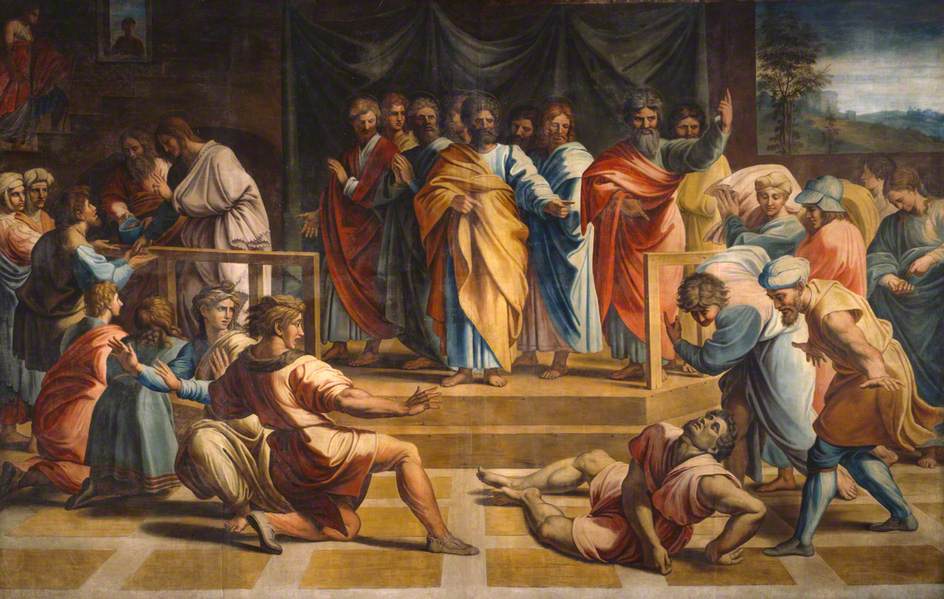
One brother by the name of Barnabas sold his farm and brought the money to the apostles. Another couple, Ananias and Sapphira, wanting to give the impression that they were just as generous, sold their property but kept back part of the proceeds for their own use, pretending they were giving it all. However, when he brought the money to Peter, Peter confronted him, saying, “Ananias, how is it that Satan has convinced you to cheat the Holy Spirit and keep back for yourself part of the price of the land? Before the land was sold, it was yours; and after the sale you were free to do whatever you pleased with the money. What has come over you? You have not lied to men, but to God!”

Upon hearing Peter’s words, Ananias collapsed and died. Fear struck everyone in the room. Some young men got to their feet and after wrapping up his body carried him out and buried him. About three hours later Ananias’ wife came in not knowing what had taken place. Peter spoke directly to her, “Tell me, did you sell your land for so much?”

“Yes,” she answered, “that was the price.”

Then Peter said to her, “How could the two of you have agreed to test the Spirit of the Lord like this? Listen, I hear the footsteps of the men who have just buried your husband coming back through the door. Now they will carry you out.” Immediately she collapsed and died. When the young men came into the room, they saw her lying dead at Peter’s feet. They carried her out and buried her beside her husband. The whole community of believers, indeed everyone who heard about it, was filled with holy fear.

The Sequel – Day 3

April 10, Friday

43_PeterHealsLame-300x150One afternoon Peter and John were on their way to the Temple for the three o’clock hour of prayer. Included in the crowd was a man who had been lame from birth.  Every day his friends would carry him to a spot near the Beautiful Gate of the Temple so that he could beg from the people as they went in. When he saw Peter and John passing by, he asked them for a donation.

Peter and John looked intently at the man and Peter said, “Look at us!” So he did, hoping to get a gift. “I know you’re expecting us to hand you some money,” Peter said to him, “but we don’t have any. I can give you something, though. In the name of Jesus Christ of Nazareth, get up and walk!”

Peter took him by the right hand and helped him up. Immediately his feet and ankles were strengthened.  He jumped to his feet, stood there for a moment, and then began walking and even leaping. Unable to contain himself, he accompanied Peter and John into the Temple shouting praises to God.

Everyone could see that this was the same beggar who used to sit at the Beautiful Gate. They were amazed by what had happened to him. While the man clung to Peter and John, a huge crowd gathered around them on Solomon’s Portico.

Peter took advantage of the impromptu meeting and said, “Men of Israel, why are you so surprised at this, and why are you staring at us as though we possess some supernatural power or ability? No, the God of Abraham and Isaac and Jacob, the God of our fathers, is the One Who has healed this man.

“And He did it to call your attention to His servant, Jesus — yes, Jesus, Whom you handed over to Pilate and disowned even while Pilate was anxious to release Him. You, brethren, turned your back on the Holy and Righteous One, preferring instead the murderer, Barabbas. You killed the Prince of life; but God raised Him from the dead, a fact of which we are eye-witnesses.

“It is the name of this same Jesus that has cured this lame man because we believe the Truth about Him. Do you understand? It is our trust in Christ that restored him to perfect health as you can clearly see.

“Brothers, I realize that you had no idea what you were doing any more than did your leaders. But just as God had foretold through all His prophets, the Messiah had to suffer. It has all been fulfilled.

“Now you must repent of your willful rejection and turn to God so that your sins may be wiped out and your souls may enjoy rich times of refreshment coming down from the presence of God. Only then will He send back Jesus, your Messiah. For now, He must remain in Heaven until that universal restoration which God promised in ancient times through all His holy prophets.

“Moses, for instance, said, ‘The Lord your God will raise up for you a Prophet like me from your brethren. You’d better listen to what He says because anyone who rejects Him will be destroyed.’ And Moses was only the first of a long line of prophets through whom God foretold the events we’ve just experienced.

“Listen! Don’t squander the incredible advantage you’ve been given: You are the very descendants of those prophets. You are heirs of the original agreement God made with our forefathers when He said to Abraham, ‘In your seed will all the families of the earth be blessed.’

“God sent His servant Jesus to you first after He raised Him to life. God is now offering to rescue you from your evil ways.”

While they were still talking to the people, the priests, the captain of the Temple guard, and the Sadducees approached them. The Sadducees, who deny the concept of resurrection and life after death, were furious that Jesus’ followers were teaching the masses about His resurrection. So they had them arrested and held in jail until the next morning.

That didn’t stop the people from believing, however. In just a matter of days there were nearly five thousand who had embraced the Message.

The Sequel – Day 2

April 9, Thursday

pentecostThese prayer gatherings continued day after day. On Sunday morning, the day of Pentecost, they had met at the Temple for prayer when suddenly the place was filled with the sound of a mighty rushing wind from heaven. Then, right before their eyes, a burning tongue-shaped flame of fire settled above the head of each person. They were all filled with the Holy Spirit, and He caused them to speak in different languages.

It just so happened that devout Jews from around the world were gathered there for the Feast.  Many hurried to the area where this phenomenon was occurring. As they listened, each heard the Message in their own mother tongue.  They were shocked and filled with awe. There were folks from Mesopotamia, Judea, Cappadocia, Pontus, Asia, Phrygia, Pamphylia, Egypt and other parts of Africa. In the crowd were Parthians, Medes, and Elamites as well as visitors from Rome, Crete, and Arabia. “Aren’t those guys from Galilee? How is it possible that we are all hearing the same Message about God’s mighty deeds yet in dozens of very different languages?” they asked in astonishment. “What on earth is going on here?”

Some onlookers suggested that the group had gotten drunk and were just blabbering; but Peter stood and spoke so all could hear, “Men of Judea, residents of Jerusalem, hear what I have to say! These men are not drunk.  Why, it’s only nine o’clock in the morning. What you are experiencing is nothing less than the fulfillment of Joel’s prophecy.

“Hear the Word of the Lord: ‘And it shall be in the last days that I will pour out My Spirit upon all mankind. Your sons and daughters will prophesy, your young men will see visions, and your old men will dream dreams. I will even pour My Spirit on slaves and servants, men and women alike, who also will prophesy.

“‘Heaven and earth will erupt in signs and wonders: blood, fire, and smoke, the sun darkened and the moon turned blood-red. Then the magnificent Day of the Lord will come, and whoever calls on the name of the Lord will be rescued.’

“Now, people of Israel, hear me out! As you well know, Jesus of Nazareth lived among us and, with power given Him by God, performed miracles, signs, and wonders. But you, using the arm of godless Rome, nailed Him to a cross and murdered Him. God knew you would do that; He had it all worked out in advance.

“God raised Him to life, defeating death in the process. David testifies in Psalm 16 that it was impossible for the Lord to be held in the grave: ‘The Lord is always present with Me, even at My right hand, that I may not be shaken; that is why My heart rejoiced, My tongue sang for joy; and My flesh can rest in hope, because You will not leave My soul in Hades, nor will You allow Your Holy One to see corruption. You lead Me into life; You make Me truly happy in Your presence.’

“Now brethren, we all know that David was not speaking about his own body in these verses. We know where his grave is right here in Jerusalem. So to Whom was he referring?

“The fact is that David was a prophet. He knew that God had promised a descendant of his Who would reign forever, and in this psalm David spoke of the resurrection of that Messiah. It was none other than this Messiah, Jesus, Who was not abandoned in death and Whose body could not decay. Yes, God raised Him up. Every one you see standing here is an eye-witness of that fact!

“Not only is He alive and well, but just as He promised, He has taken the place of honor at the right hand of the Father and poured out His Spirit on us this very day, which is what you are witnessing.

“Hear again the words of David, ‘The Lord said to my Lord, “Sit at My right hand until I make Your enemies Your footstool.”’ Now David, as we know, never ascended to Heaven.  He was, again, writing prophetically concerning the Messiah.

“What does all this mean? Listen, nation of Israel! Know beyond the shadow of a doubt that this same Jesus, whom you crucified, is our Messiah and has been declared by God to be Lord of all.”

Peter’s scathing exposé pierced their hearts and they cried out, “Brothers, now what do we do?”

Peter answered, “You must confess what you have done, turn away from your sin, and every one of you must be baptized in the name of Jesus Christ. Then your sins will be forgiven and you, too, will receive the gift of the Holy Spirit. This incredible promise is available to you and your children — yes, and for all who are far away, for as many as the Lord our God shall call to Himself!” Peter spoke at length and explained further, urging them to escape from their perverted generation.

The crowd received the Message with open arms. Some three thousand were baptized and added to the number of Christ-followers that first day. They returned to the temple daily to learn more from the apostles and bonded deeply as they opened their homes to each other, sharing meals and praying together.

Everyone felt a deep sense of awe at what God was doing. In addition to the miracles being performed by the apostles, a new sense of community began to form as those with property or possessions sold them to meet the needs of others. Praising God for their newfound joy, they shared everything in common. These developments caught the attention of many others, and every day the Lord added more people to the ranks of the “saved.”

The Sequel – Day 1

Don’t STOP now!!  The Story of Jesus isn’t over!
Let’s take the next few weeks to read The Sequel and The Finale!
We’ll wrap it up on Ascension Day (May 14)!

April 8, Wednesday

AscensionDear Theophilus,

I am compelled to offer you this historical supplement to my previous work which provided an orderly record of the life and teachings of Jesus. As you will soon see, His story continues.

After Jesus’ suffering and death He showed Himself to His followers, leaving no doubt in their minds that He had, in fact, risen from the dead. This was no one-time apparition. He appeared many times over the next forty days and discussed with them matters related to the Kingdom of God.

During one of their last meals together, Jesus specifically instructed His disciples to stay in Jerusalem and wait until the Holy Spirit came, initiating them into their new life. “Remember My Father’s promise to you,” He told them.  “John used to baptize with water, but in a few days you will be baptized with the Holy Spirit.”

The disciples, trying to figure out what that meant, asked, “Lord, does that mean You are ready to restore the Kingdom to Israel now?”

“I’ve told you before that only the Father knows when He plans to bring an end to the current era,” Jesus explained. “The purpose for sending the Spirit is to empower you as My chosen witnesses. You will carry My Message from here in Jerusalem throughout Judea and Samaria, and then to the far corners of the earth.”

Jesus had barely finished this commission when He began to ascend up into the clouds. The disciples stood staring up to where He had disappeared from sight. Suddenly someone was standing beside them on the Mount of Olives who asked, “Men of Galilee, why are you standing here looking up into the sky? This very Jesus Who has been taken up from you into Heaven will come back in just the same way as you have seen Him go.” They turned to see two men in dazzling white robes.

What to do now? The eleven disciples, Peter, John, James, Andrew, Philip, Thomas, Bartholomew, Matthew, James the son of Alphaeus, Simon the Patriot, and Judas the son of James, returned the half-mile to Jerusalem and gathered in the upper room where they had been staying. Every day they met in the temple together with several of the women who had followed Jesus, and also Jesus’ brothers and his mother Mary. For the next ten days they devoted themselves to waiting on the Lord in prayer.

________________

At one point Peter stood to make a proposal. To the assembled company of one hundred twenty followers he said, “My brothers, we have witnessed the fulfillment of the prophecy of Scripture given through the Holy Spirit by the lips of David. Judas, who was counted as one of us and ministered alongside us, betrayed Jesus that night in the garden when he led the troops there to arrest Him. We know what happened to him: the field bought with his blood money and his own life ending there in disgrace. All of Jerusalem is aware of it and calls the place Akel dama or ‘Field of Blood.’

“The Psalmist also declared, ‘Let his home be abandoned, so that no one lives there,’ and ‘Let someone else fill his position.’ In light of that,” Peter concluded, “we need to choose a successor. It has to be someone who has been alongside us faithfully the whole time, from the day the Lord Jesus was baptized right up to a few days ago when He was taken up from us. The man we choose must also be an eye-witness of the Lord’s resurrection.”

Two of the men present fit those qualifications so they set before them Joseph, who was called Barsabbas by some and Justus by others, and Matthias. Then they prayed, “O Lord, You alone know the hearts of all. Show us which of these You have chosen to fill the role which Judas, the traitor, abandoned in order to go where he belongs.” Then they cast lots and it fell to Matthias who from then on was counted among the apostles along with the original Eleven.